
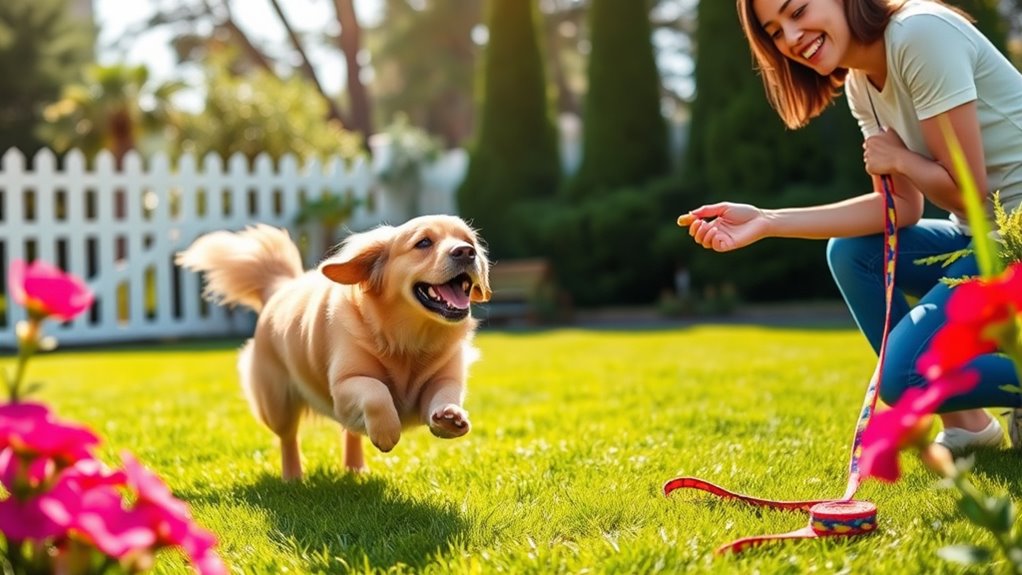
10 Steps to Train Your Dog to Come Every Time
To train your dog to come every time, start by pairing their name with praise and treats to get their attention. This builds a positive connection with their name, making them more likely to respond. Use “Follow Me” exercises next to encourage your dog to stay close and engaged.
Once they’re comfortable, practice with a long line outdoors for safety. This way, they can explore while you still have control. Introduce distractions gradually, so they learn to come even when things get exciting around them. Always reward successful recalls with high-value treats and fun games to keep it positive.
Avoid calling your dog to punish—it can make them hesitant to come. Consistency is key, so keep practicing regularly. Boost recall speed with playful turns and enthusiastic praise.
Keep going, and you’ll uncover even more effective tips and tricks to strengthen your dog’s recall every time!
Key Takeaways
- Start by associating your dog’s name with positive reinforcement in quiet settings to build focus and recognition. This helps your dog learn that hearing their name means good things are coming.
- Train recall at close distances with high-value treats before gradually increasing distance and distractions. Keep it fun and rewarding so your dog wants to come every time.
- Practice recall in varied environments and progressively introduce distractions to generalize the behavior. This way, your dog learns to come no matter where you are or what’s going on around them.
- Use a long training line for safe outdoor practice, reinforcing positive associations with treats, praise, and play. It’s a great way to give your dog freedom while still keeping control.
- Consistently reward recalls with enthusiasm and never use the command for punishment. This keeps your dog motivated and makes coming to you something they actually look forward to.
Start With the Name Game to Improve Recall Attention

One simple yet effective way to boost your dog’s recall is to start with the Name Game. This technique helps you teach your dog to recognize their name by consistently pairing it with positive reinforcement like treats or praise.
Begin practicing the Name Game daily in a quiet spot, calling your dog’s name and immediately rewarding them when they look at you. Keep these sessions short—around one minute—to hold their interest and avoid frustration.
Using your dog’s name before giving any command further strengthens their recognition and guarantees they respond reliably when called. Try to incorporate the Name Game into your daily routines, such as mealtimes or playtime, to build their focus and attention naturally.
Use Follow Me to Improve Recall and Stay Close

To improve recall, you want your dog to stay close and follow you consistently. The Follow Me exercise helps encourage this close proximity by rewarding your dog each time they stick by your side.
With regular practice, your dog will learn to keep up and respond reliably, even with distractions around. It’s all about making sure your dog knows that staying close is the best choice.
Encouraging Close Proximity
When you encourage your dog to stay close using the Follow Me exercise, you strengthen their recall and improve their ability to stick by your side. Start in a quiet space with minimal distractions, using the cue “Follow” or “Let’s go” to prompt your dog to stay near.
Reward them immediately with high-value treats and enthusiastic praise when they follow without pulling ahead. Gradually increase distance and distractions to build reliability.
Try to incorporate Follow Me during walks and play to naturally reinforce coming when called and maintaining close proximity. It really helps make those moments together even better.
| Feeling | Situation | Result |
|---|---|---|
| Joy | Dog stays close | Stronger bond |
| Confidence | Reliable recall | Safer outings |
| Pride | Dog responds promptly | Training success |
| Love | Shared moments walking | Deepened connection |
Building Consistent Following
Although building consistent following takes patience, using the Follow Me exercise makes it easier to improve your dog’s recall and keep them close.
To teach a dog this skill, start in a distraction-free space, calling them to follow while offering high-value treats. Use a clear, consistent cue like “Follow Me” to prompt them to walk beside you.
As your dog masters this, slowly increase distance and introduce mild distractions, ensuring they stay attentive to your command. Reward your dog lavishly each time they respond promptly and remain close.
Try to incorporate Follow Me into daily routines—during walks or play—to reinforce consistent following. This approach not only strengthens recall but also builds a reliable habit of staying nearby, making your dog more responsive and easier to manage in various environments.
Try Restrained Recall to Practice Controlled Come

Try the controlled release technique by having a helper hold your dog on a leash while you call them, then letting them go to come to you. Reward your dog enthusiastically with treats and praise when they respond correctly.
This method builds a safe, reliable recall before you try off-leash training. It’s a great way to practice controlled come and make sure your dog understands what you want.
Controlled Release Technique
Since building reliable recall requires control, the Controlled Release Technique uses restrained recall to practice a focused come. You’ll have a helper hold your dog on a leash or long line, calling them cheerfully.
Once the dog responds and reaches the helper, they’re released to run freely. This controlled release teaches your dog to come reliably from a restrained position, associating the recall with positive outcomes.
Gradually increasing distance and distractions during restrained recall strengthens this behavior in different environments.
| Step | Description |
|---|---|
| Hold | Helper restrains dog on leash or long line |
| Call | Use a cheerful recall cue |
| Release | Let dog run freely upon responding |
| Repeat & Increase | Practice with greater distance/distractions |
Rewarding Successful Recall
One key to building a reliable recall is rewarding your dog immediately after they come to you during restrained recall exercises. When a helper holds your dog on a leash and releases them on command, your dog learns to associate the recall cue with a controlled, fun run back to you.
Make sure to reward your dog with high-value treats right away to reinforce this positive behavior. Start practicing in a distraction-free environment so your dog learns to respond reliably before adding challenges.
Consistent repetition and enthusiastic praise during restrained recall help your dog build confidence and understand that coming when called always leads to something good. This approach strengthens your dog’s recall and sets the stage for success in real-world situations.
Add Whiplash Turns to Boost Recall Speed
When you toss a treat behind your dog and call them back quickly, you create a whiplash turn that sharpens their recall speed and agility. Whiplash turns involve your dog making a sharp, quick directional change to retrieve the treat, then rushing back to you for praise.
This exercise boosts recall speed by encouraging fast, responsive movements. Incorporate whiplash turns into your training sessions by gradually increasing the distance and adding distractions. This builds your dog’s confidence and enthusiasm to come when called, even in challenging situations.
Using treats and enthusiastic praise during each turn keeps the exercise fun and motivating. Over time, these quick directional changes improve your dog’s agility and make their recall more reliable.
Make Coming Fun With High-Value Rewards
Although training recall can sometimes feel challenging, using high-value rewards instantly makes coming back exciting for your dog. When you use high-value treats like cooked chicken or cheese, your dog quickly learns that coming every time means something special.
To boost motivation, combine tasty rewards with fun activities that your dog loves. It’s all about making the experience something they look forward to.
Here’s how to make coming irresistible:
- Use high-value treats exclusively for recall training to create a strong incentive.
- Incorporate play, like favorite toys or games, to make the experience enjoyable.
- Shower your dog with praise and affection immediately after they come to reinforce the positive connection.
Keep it fun and rewarding, and you’ll see your dog eager to come every single time!
Gradually Increase Distance When Calling Your Dog
As your dog masters coming at close range, start calling them from gradually increasing distances to build their reliability. Begin at just a few feet, like 2-3, and only move further away once your dog responds promptly and enthusiastically.
Use high-value treats and enthusiastic praise to reinforce their recall at each new distance. Incorporate a long line of 30 feet or more to maintain control while safely practicing at greater distances.
This training method helps your dog understand that coming when called is rewarding no matter how far away you are. Always practice in a distraction-free environment first to ensure your dog is focused on you.
Consistency is key—only increase distance when your dog reliably comes to you. By gradually increasing distance during training, you build your dog’s confidence and responsiveness, setting the stage for reliable recall in any situation.
Introduce Distractions Step-by-Step to Proof Recall
Start by adding mild distractions like toys or sounds during your recall practice, then gradually increase the challenge with other dogs or people.
Train your dog in different places—backyard, park, or neighborhood—to make sure they respond anywhere.
Keep rewarding your dog with high-value treats and praise when they come despite distractions, reinforcing the behavior every time.
It’s all about taking it step-by-step and keeping things fun for your pup!
Gradual Distraction Increase
Because distractions can easily break your dog’s focus, you’ll want to introduce them gradually when training recall. This gradual distraction increase helps your dog build reliable responses even in challenging situations.
Start in a quiet spot, then slowly add mild distractions like toys or background sounds. Once your dog responds consistently, up the difficulty by including more distractions such as other people or pets.
Focus on these key steps during your training:
- Begin with low-distraction environments to set a strong foundation
- Introduce mild distractions carefully to avoid overwhelming your dog
- Progress only when your dog reliably comes every time
Diverse Training Environments
When you want your dog to come every time, training in diverse environments is essential to proof recall. Start by practicing in familiar spots like your backyard. Then, gradually introduce new places such as parks or your neighborhood.
This helps your dog generalize the recall command across different settings. Gradually add distractions, beginning with minor household noises. Later, move up to more intense stimuli like other animals or people.
Use high-value treats and positive reinforcement consistently to keep your dog motivated despite distractions. If your dog struggles, simply reduce distractions or increase rewards to make sure they succeed.
Use a Long Training Line for Safe Outdoor Recall Practice
If you want to build your dog’s recall skills safely outdoors, a long training line of 30 feet or more is essential. This long leash gives you control while allowing your dog the freedom to roam. It makes recall training both effective and safe.
Avoid retractable leashes, as they can be unpredictable and often get in the way of proper training.
Use the long line to gradually increase the distance during recall exercises. Keep a firm grip or even secure the leash around your waist to prevent tangles and maintain safety.
Practicing in different outdoor settings with the long leash helps your dog gain confidence and become more reliable.
Key benefits of using a long training line include:
- Safe control during extended recall training sessions
- Gradual distance increase to build strong recall habits
- Flexibility to practice in various outdoor environments
With consistent use of a long leash, your dog will learn to come every time, even when distractions are around. It’s a simple tool that makes a big difference!
Prevent Negative Associations With the ‘Come’ Command
To keep your dog enthusiastic to respond, always use the “come” command in a positive context and never associate it with something unpleasant. Avoid calling your dog to punish or scold, as this can create negative associations that make them hesitant or fearful of coming when called.
Instead, focus on reward-based training by consistently praising, offering high-value treats, or engaging in quick play sessions when your dog responds promptly. Use a happy, upbeat tone to make the experience enjoyable and reinforce that coming to you is a good thing.
If your dog is slow to respond, don’t punish or show frustration—this can damage their willingness. By maintaining consistency with the “come” cue and prioritizing positive interactions, you guarantee your dog views recall as a rewarding activity.
This approach strengthens your bond and makes training more effective, turning the “come” command into a fun and reliable part of your dog’s behavior.
Involve Family and Play Games to Reinforce Recall
Including your entire family in recall training guarantees your dog learns to respond reliably no matter who calls them. This strengthens their obedience in various situations.
When everyone gets involved, your dog associates the command with positive experiences. That makes it easier for them to come quickly and enthusiastically.
To reinforce recall, play games like hide-and-seek or fetch during training sessions. These activities keep your dog engaged and motivated to respond.
You can also have family members call your dog from different spots around the house or yard. This increases their ability to come no matter where they are.
Here’s how to make recall training effective with your family:
- Use treats, praise, or play games as rewards when your dog comes.
- Rotate who calls your dog to build response consistency.
- Practice during family activities to build your dog’s confidence and trust.
Frequently Asked Questions
What Is the 3-3-3 Rule for Dog Training?
The 3-3-3 rule means you should see noticeable training progress within three weeks. Expect solid command understanding by three months, and stay patient throughout.
You’ll set small goals, track progress, and adjust your training as needed. It’s all about being consistent and giving your dog time to learn.
What Are the Chances of a Dog Coming Back After Running Away?
If your dog’s well-trained with consistent recall practice, there’s over an 80% chance they’ll come back after running away. Without proper training or positive associations, distractions lower those chances considerably.
What Is the 7 7 7 Rule for Dogs?
Think of the 7 7 7 rule as planting three small seeds daily—each 7-minute session in different spots.
You’ll nurture your dog’s recall by keeping training short, varied, and rewarding.
This way, you grow trust and response steadily.
What Are the 7 Basic Dog Commands?
The seven basic dog commands you should teach are sit, down, stay, come, heel, leave it, and drop it.
These commands help you communicate clearly with your dog and keep them safe and well-behaved.
Teaching these basics makes life easier for both of you, and your dog will feel more confident too!
Conclusion
Training your dog to come every time isn’t just about commands—it’s about building trust and fun. Like planting seeds that grow into a strong, reliable bond, each step you take brings your dog closer to perfect recall.
Remember, patience and consistency turn training into a joyful journey, not a chore. So, keep practicing, stay positive, and watch your dog come running with excitement every single time—you’ve got this!
With these 10 steps to train your dog to come every time, you’re setting the foundation for a well-behaved, happy pup. Consistent training builds trust and makes recall second nature for your dog. Keep the experience fun and rewarding, and you’ll see amazing results. Stick with patience, positivity, and regular practice, and your dog will come running every time you call—making both of your lives easier and more enjoyable!






3 Comments